RTK GPS Explained: Why Tree Cover Decides Whether a Wire-Free Mower Works
RTK is the technology that let robot mowers drop the boundary wire, and it is also the reason wire-free mowers get returned. The physics is simple and unforgiving: the mower only knows where it is to within a couple of centimeters while it and a fixed antenna can both see enough satellites. Understand that one constraint and you can predict, standing in your own yard, whether a wire-free mower will work before you buy it.
What the reference antenna is doing
A GPS receiver on its own is accurate to a few meters, because the satellite signals bend and slow on their way through the atmosphere. RTK adds a second receiver at a fixed, known point (the reference station, usually a small antenna on a pole or roof) that measures those errors continuously and radios the correction to the mower. With both receivers seeing the same satellites, the error cancels and the mower's position is good to about two centimeters. That is what lets it stop at a virtual line with no wire in the ground.
The correction only works while both ends have a clean fix. The antenna is the half people neglect: mount it low behind the house, under an eave, or beside a tree and the mower inherits its bad view. Makers want the antenna high with a clear cone of sky above it, ideally on the roof or a two-meter pole in the open, with the mower's whole working area in its radio range. Owners who moved the antenna from the deck rail to the roof describe it as fixing 'a defective mower'.
How much shade is too much
Every RTK mower carries an inertial sensor and wheel odometry, so it can dead-reckon across a shaded strip for a short distance and pick the fix back up on the other side. The current generation adds cameras (Segway's X3, Mammotion's Luba 2 AWD X, Ecovacs's newer GOATs) that recognize landmarks and grass edges to stretch that distance. What none of them can do is mow a lawn that is mostly under canopy, because the fix never returns.
A working rule from owner reports: if a third or more of the grass is under mature trees, or the lawn is a strip between two houses, RTK will frustrate you and LiDAR or boundary wire is the right class. Deciduous trees add a seasonal twist. A yard that maps fine in March can lose its fix in June when the canopy fills in, and the map has to be re-driven or the schedule changed. Evergreen canopy is a permanent no.
What 'RTK signal lost' looks like in practice
The mower stops, waits for the fix to return, then continues; if it waits too long it returns to the dock and the app logs a positioning error. Under intermittent shade this looks like a mower that mows in fits and starts and takes twice as long as its rated time. Under real canopy it looks like a mower that mows the open half of the lawn and never finishes the rest. Neither is a defect, and neither is fixed by firmware; the sky is the sky.
Two things do help. Moving the antenna is the first and cheapest. The second is the cellular RTK service some brands offer (Segway, Mammotion, Husqvarna's EPOS on some models), where the correction comes from a network of fixed stations over 4G rather than from your own antenna; it removes the antenna placement problem but not the mower's own need for sky, and it carries a subscription.
Setup, honestly
Mount the antenna, plug in the base, let the mower acquire satellites, then walk the perimeter with the phone as a joystick. Budget an hour the first time and expect to redo a corner or two. Mark islands (beds, trees, the trampoline) the same way. Narrow passages under about two feet wide are the classic setup trap: the mower needs room to turn, so passages want either a wider mowing lane or a defined channel in the app.
Once the map is in, the payoff is real: change it in minutes when you add a bed, add a second zone across the driveway, set no-go areas around the sprinkler heads. Owners who came from wire mowers describe the map editing as the thing they'd never give back. Just make the sky check first.
Mowers mentioned in this guide
Segway
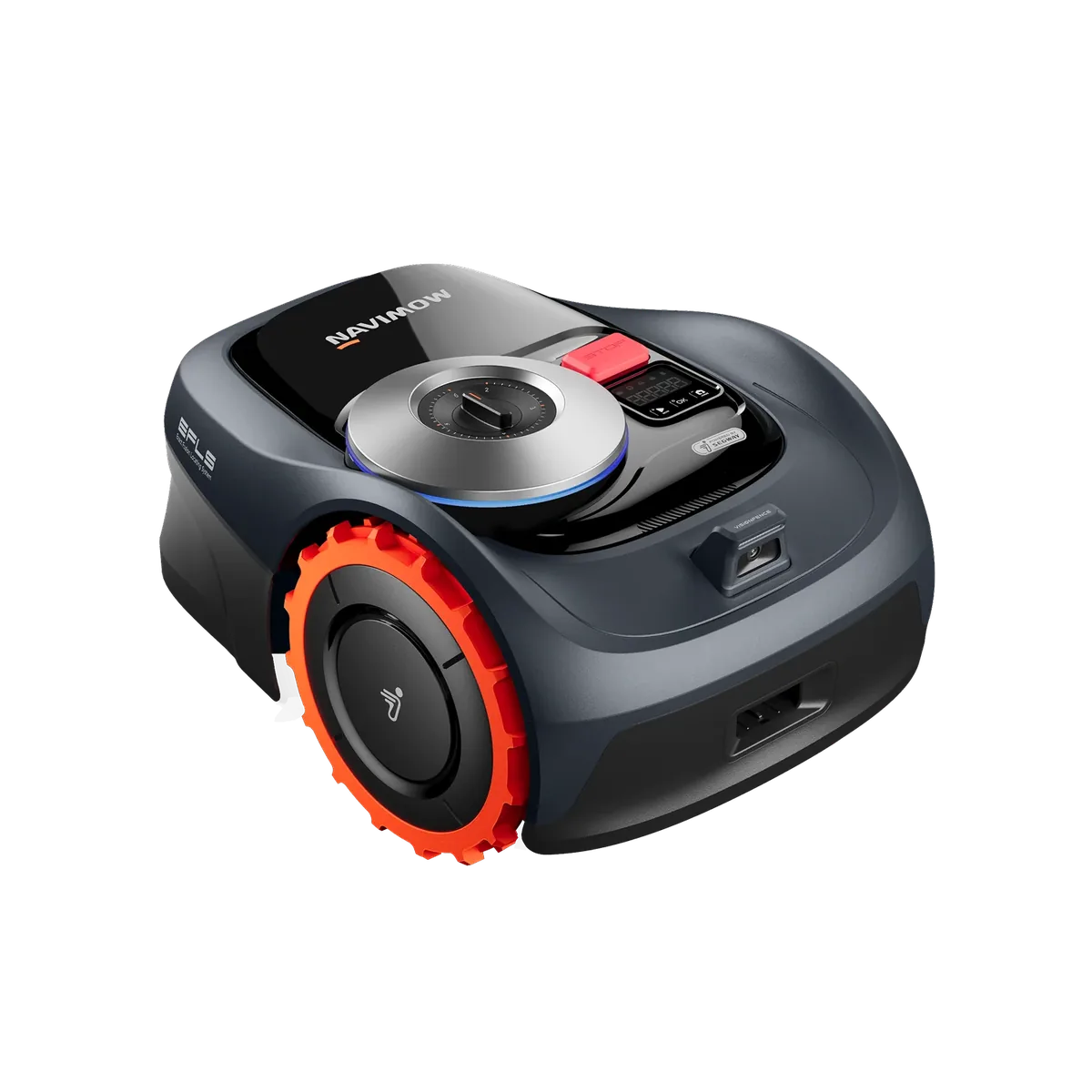
Segway Navimow i110N
The i110N is the same 7.1 in body as the i105N with double the battery (5.1Ah, about 120 minutes per charge) so it can cover a quarter acre, and it won Tom's Guide's Editor's Choice for cut consistency at a price that has slid from $1,299 at launch to a $929 list and frequent sub-$800 sales. It uses Segway's EFLS 2.0 RTK plus a front VisionFence camera, so when the satellite fix wobbles under trees it can hold the boundary visually for a while instead of wandering off. Reviewers consistently praise the straight, overlapping stripes with no missed patches and the near-silent 58 dB operation that makes night mowing realistic. The complaints are the flip side of the budget price: it is slow (Tom's Guide clocked roughly three times the time of push mowing), the 30% slope rating and front-wheel drive mean it spins out on real hills, PCWorld's unit repeatedly drove off curbs because there is no drop-off detection, and GPS anti-theft needs the $120 Access+ 4G module. Segway has pulled it from its own store in favor of the i210 AWD, but Home Depot still stocks it. For a flat quarter-acre suburban lot it remains one of the cheapest dependable wire-free options; if your yard has slopes or a parking strip, look at the i210 AWD or a Luba Mini instead.
Ecovacs
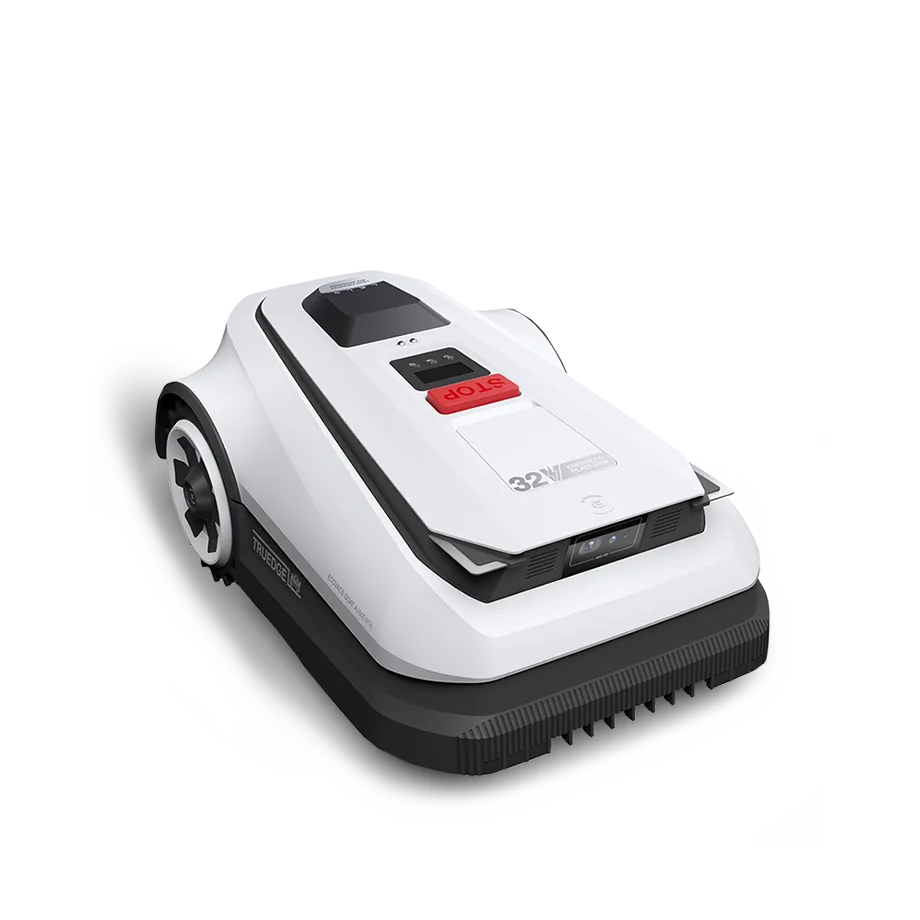
Ecovacs GOAT A2500 RTK
The GOAT A2500 RTK was Ecovacs' 2025 flagship and it is now the value play in the range: the list price is still $1,999.99 but Amazon has sold it between $1,500 and $1,750 for most of 2026. You get the 32V dual-disc deck with a 12.99-inch cut, 50% slope capability, and a LELS RTK antenna backed by a 3D ToF sensor and AI camera so it keeps its bearings under moderate tree cover. The 3 Ah battery charges in about 45 minutes, which matters because runtime is only about 64 minutes; Ecovacs' own math is 5,382 sq ft per charge. Owners are split. Happy ones describe mowing three separate yards every couple of days, a useful live map, and a mower that frees itself when stuck. The unhappy ones (and the Amazon average sits in the low 3s) report RTK dropouts, hectic spot-turns that dig into turf, edge passes that back off when plants overhang a bed, and nagging app pop-ups. Notebookcheck's verdict of 'fast, but not flawless' is about right. Compared with the Segway Navimow X330 it is quicker across open ground but less refined at edges, and unlike the newer A2000 LiDAR Pro it has no string trimmer. It suits open half-acre lawns with a good view of the sky where you want speed and can tolerate some fiddling; heavy shade or lots of narrow beds point you toward the LiDAR models.
Mammotion
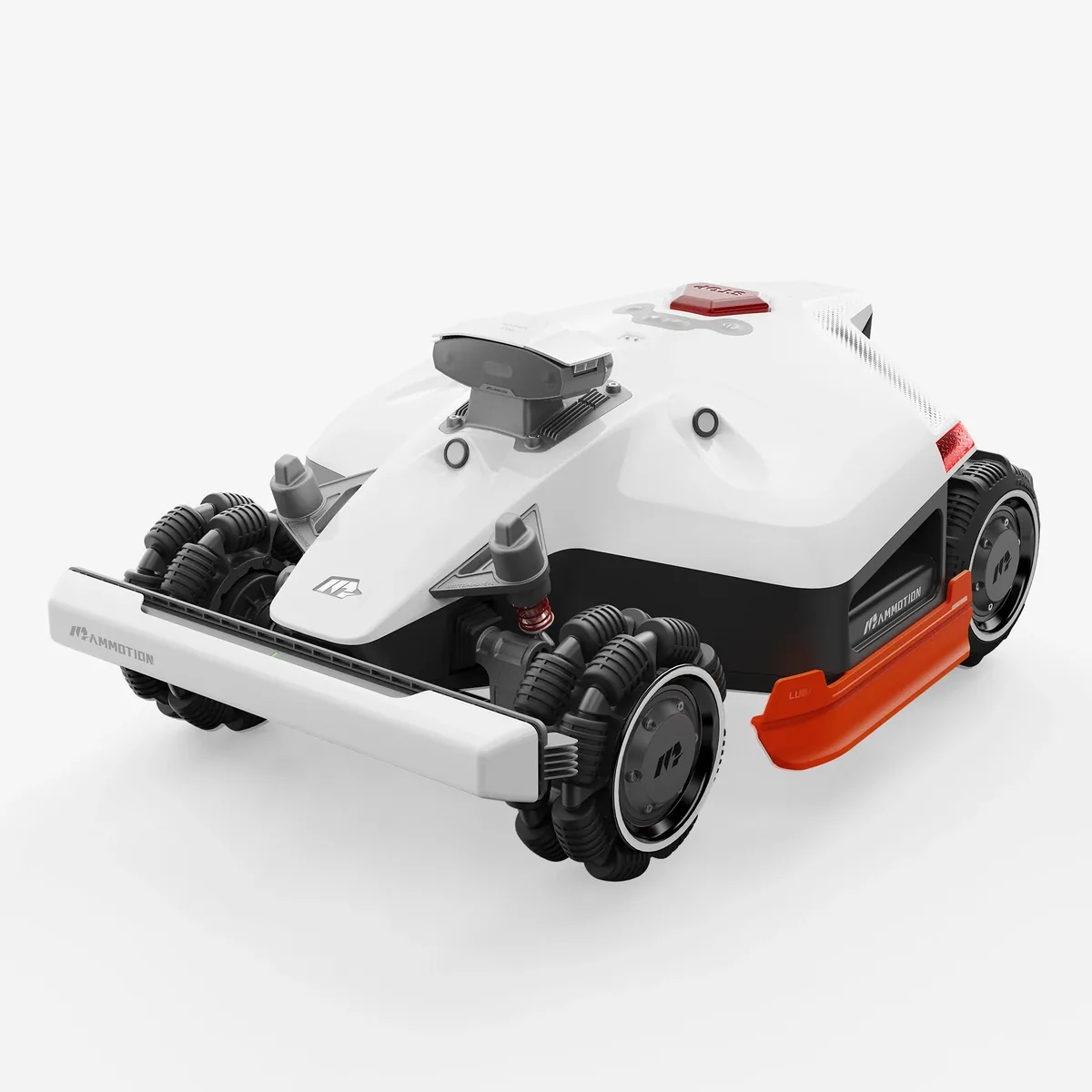
Mammotion Luba 2 AWD X
The Luba 2 AWD X is the mower that made Mammotion a household name in the US, and in fall 2026 it is a clearance buy: Mammotion's own store shows every trim out of stock with a banner pointing at the Luba 3, but Home Depot and Best Buy still have units, with the 3000X down from $2,599 to about $1,999. What you get is the same all-wheel-drive body that climbs 80 percent grades, a 15.7 inch dual-disc deck that clears a big yard fast, and a 2025 X refresh that added the UltraSense AI camera so it keeps its bearings when the RTK station loses sky. The catch is that RTK station: it must be mounted high with an open view, and most owner complaints trace back to a poorly placed antenna. The X version cuts 1.0 to 2.7 inches, so northern cool-season lawns should look for the HX (2.2 to 4.0 inches) instead. Versus the newer Luba 3 you give up LiDAR and free NetRTK, which matters if your lawn is ringed by trees; versus a Segway Navimow X3 you gain real AWD and a wider deck. Best for hilly half-acre to 2.5 acre properties with decent sky, bought on discount.