Roborock
Roborock RockMow X1
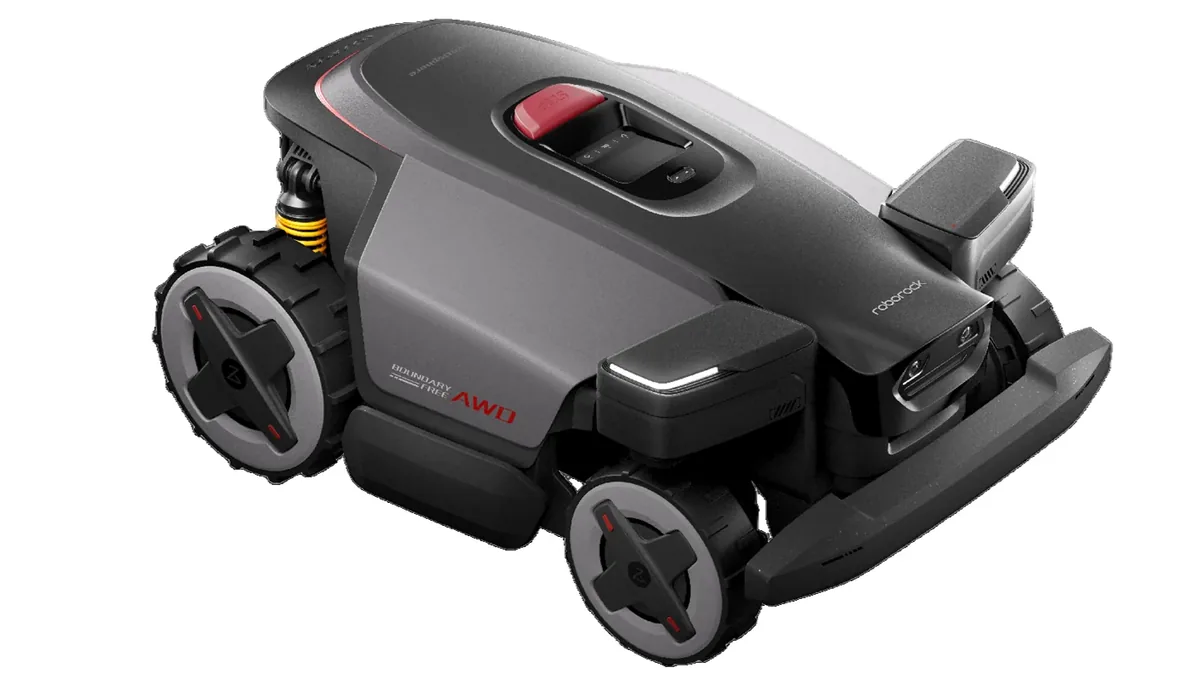
Roborock's first lawn mower landed in the US in March 2026 as the RockMow X1 (it is the Z1 everywhere else), and it is built like the robot vacuums that made the brand: overbuilt, quiet and very good at driving. Four hub motors, active front steering and dynamic suspension let it climb 80 percent grades and roll over 3 inch bumps without tearing turf, and owners say the first thing they notice is how silent it is. Positioning is full-band RTK from an included antenna plus four cameras, with a headlight so it can finish after dark. The X115H covers 0.37 acres and the X130H is rated to an acre per charge; both share a 9.5 inch deck and a 1.6 to 3.5 inch app-set height. Early owners like the mapping and app but call the software a work in progress: obstacle avoidance detours widely, zone passages need more room than the stated 2.6 feet, and the PreciEdge module that gets within 1.2 inches of borders is a $150 add-on. Amazon is the main US retailer, and the X115H has already dipped to $1,500 from $2,299. Against the Mammotion Luba 3 you trade a wider deck and LiDAR for a heavier chassis with better steering; against the Navimow X3 you gain AWD. Best for hilly, rutted yards up to an acre where traction matters more than edge precision.
We may earn a commission.
Price and availability on Amazon’s site may differ.
Coverage versions
Roborock sells the Roborock RockMow X1 as one machine with several coverage ratings. The hardware is the same; the rated area (and usually the battery) changes with the version.
| Version | Rated area | Approx. price |
|---|---|---|
| X115H · RockMow X115H | 16,117 sq ft (16,117 sq ft) | ~$1,500 |
| X130H · RockMow X130H | 1 acre (43,560 sq ft) | ~$2,500 |
Specifications
How it navigates
Full-band RTK from an included reference station fused with quad-camera VSLAM (Sentisphere); a network RTK mode that skips the antenna arrived by update. Drive the perimeter with the app joystick or use AI auto-mapping.
Highlights
Pros
- ✓Exceptional build and terrain handling; owners on 30 percent slopes and rutted ground say it does not get stuck
- ✓Whisper quiet, with a headlight so it can run at night without bothering neighbors
- ✓Clean, intuitive Roborock app with scheduling, zones, PIN lock and 4G tracking
- ✓Active front steering turns gently without scuffing the lawn
- ✓3-year warranty on the mower and steep early discounts on Amazon
Cons
- ✗Software lags the hardware: cautious wide detours around obstacles and features still arriving by OTA
- ✗Edge cutting needs the $150 PreciEdge module and still leaves a strip along fences
- ✗Needs an RTK antenna with clear sky unless you rely on the newer network RTK mode
- ✗Heavy at roughly 47 pounds and only sold through Amazon and a few dealers in the US
Compare the Roborock RockMow X1
Related robot mowers
More from Roborock →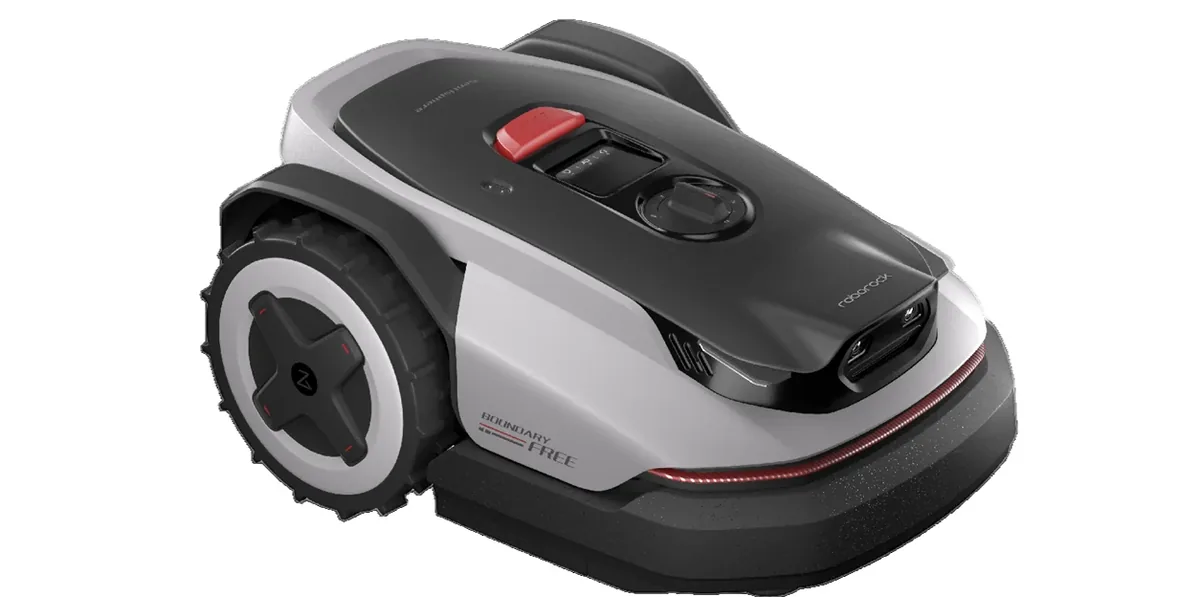
Roborock
Roborock RockNeo Q1
The RockNeo Q1 (Q110H in the US) is Roborock's entry mower: a 27 pound, rear-wheel-drive machine for quarter-acre lawns that lists at $1,299 but has been selling on Amazon for $800 to $1,000 most of the summer. It uses the same full-band RTK antenna plus camera VSLAM as the RockMow, and Roborock later pushed a network RTK mode so you can skip the antenna if you have decent cell coverage. Owners describe it as whisper quiet, good at systematic back-and-forth mowing of open lawn, and nicer to map than Segway's app, and they like the headlights for evening runs. They are also blunt that it is for simple, flat, easy yards: the plain wheels get stuck if it wanders onto rock beds or sand, it struggles on real slopes despite the 45 percent rating, and it needs a wide-open view of the sky to hold position. Cutting height is a manual dial from 1.6 to 3.1 inches, edge cutting needs the $90 PreciEdge module, and even with it the software keeps a cautious margin around anything hanging over the lawn. Compared with a Navimow i105 it is quieter and maps better; compared with a Mammotion Yuka mini it needs an antenna but climbs about the same. Best for flat, open quarter-acre lots where price and quiet matter most.
Roborock
Roborock RockMow X1 LiDAR
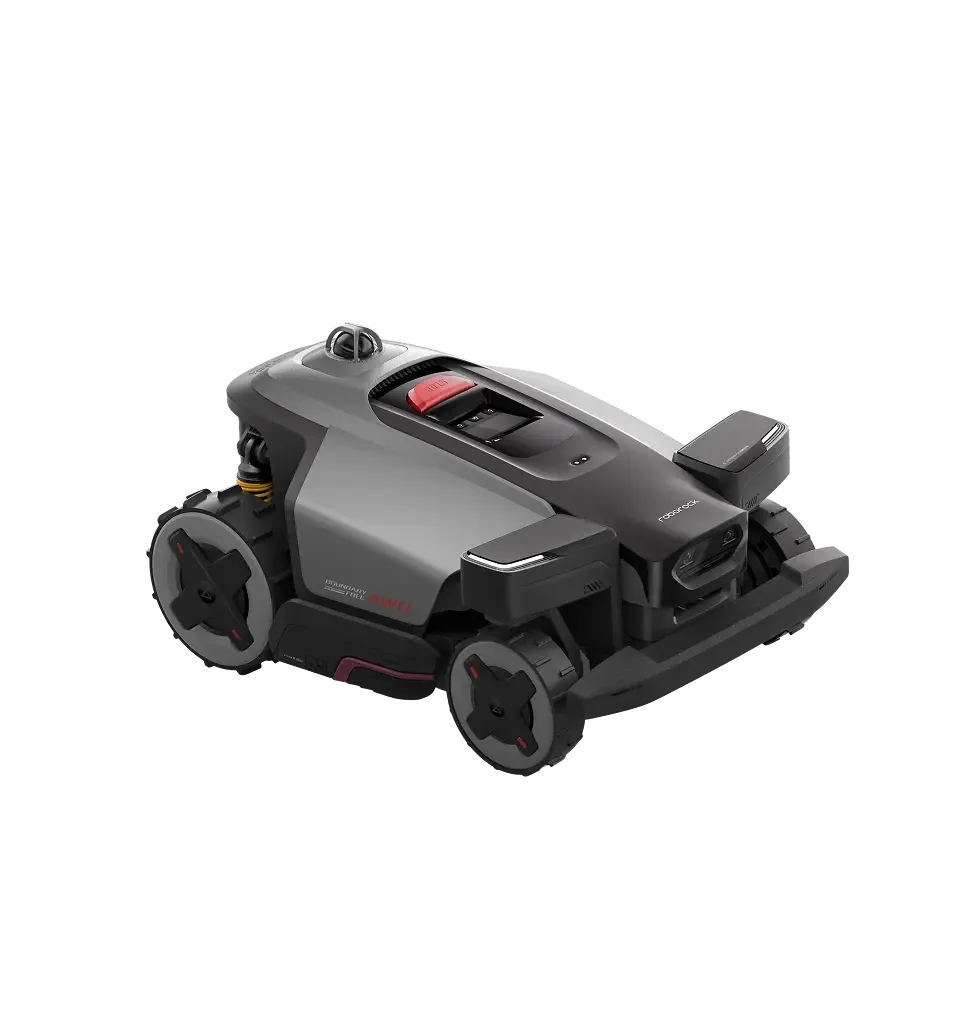
The RockMow X1 LiDAR (model X120H) is the RockMow X1's AWD chassis with a spinning LiDAR dome on top and no RTK antenna in the box. That is the whole pitch: if your lawn is hemmed in by trees, fences and a two-story house, satellite RTK mowers spend half their time hunting for a fix, whereas this one builds a 3D map of the yard and mows in straight, systematic lines regardless of sky. It launched in the US in July 2026 at $3,199 list, with a $2,499 opening deal that has since ended, and it is rated for 0.49 acres, 80 percent slopes and 3.1 inch obstacles with the same 9.5 inch six-blade deck and 1.6 to 3.5 inch app-set height as its siblings. Lab reviewers praised the navigation, the quiet motor and a clean cut, but found the obstacle avoidance weak (it drove straight over hoses and balls that cheaper mowers dodged), the AI auto-mapping non-functional at launch, and edge results disappointing even with the $150 PreciEdge module because the software keeps a wide margin. It costs more than a Mammotion Luba 3 AWD 3000, which has LiDAR, NetRTK and a wider deck, and about the same as a Dreame A2 with far less edge precision. Best for half-acre lawns with terrible sky view and real slopes, for buyers who trust Roborock to finish the software.
Airseekers
Airseekers Tron
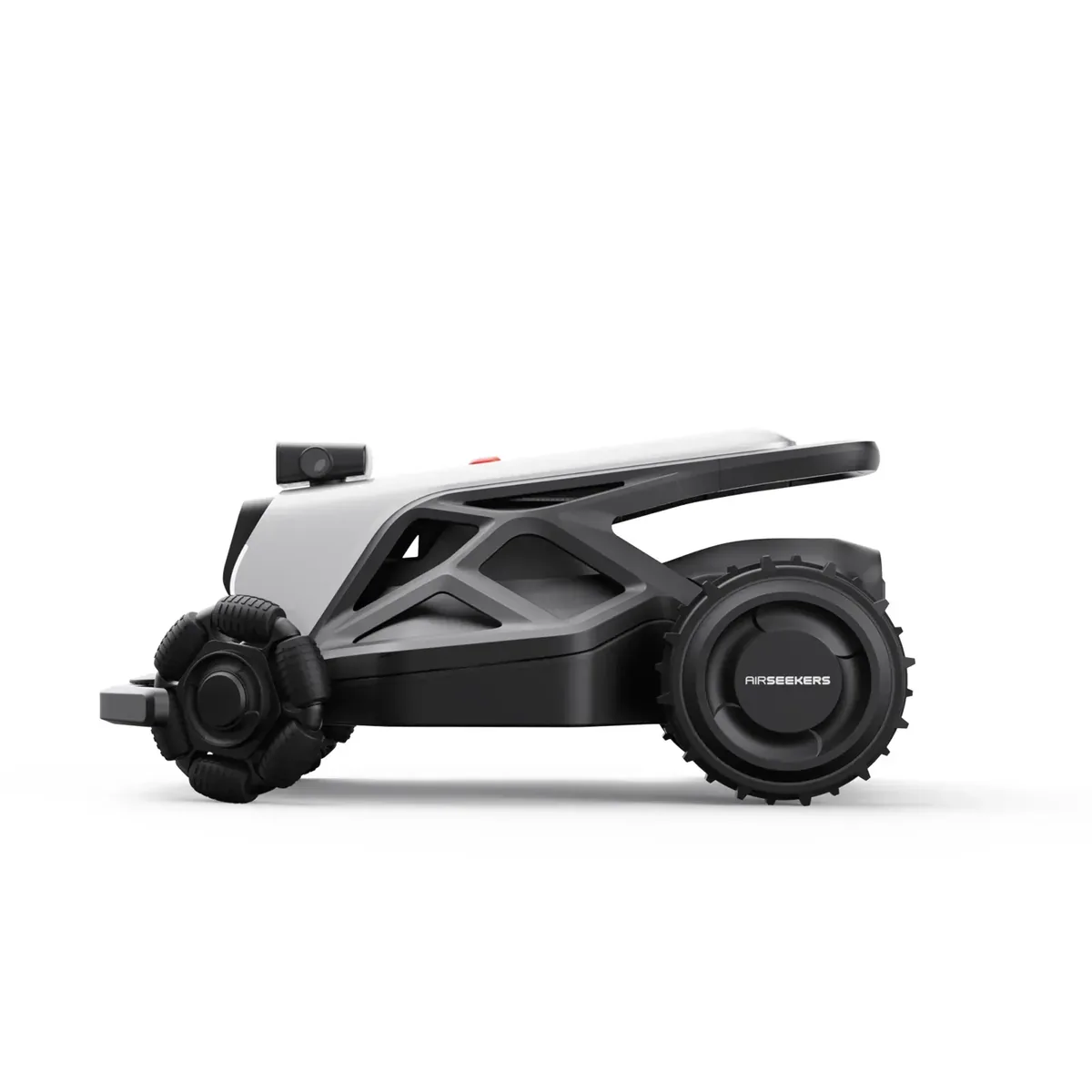
Airseekers came out of a 2024 Kickstarter with a genuinely different idea: instead of a bare disc of razor blades, the Tron uses a six-blade FlowCut deck that pulls grass upright with airflow, cuts it, and mulches it again before spreading it back onto the lawn. Reviewers at Android Authority and The Gadgeteer agreed the cut and mulch quality are excellent and that the 65 percent slope rating is real. It is also one of the cheaper wire-free mowers with 4G built in: the base Tron is regularly $1,299 for 0.59 acre a day, the Tron Plus is $2,099 for a full acre and adds LED headlights, and both share a swappable 15 Ah battery that runs about three hours, with an optional wider 11.8-inch blade disc. The weak spots are just as well documented. The toed-in front wheels can leave wavy tracks and scuff turf on tight turns, small objects below the bumper (sticks, bricks, hose) get run over, and owners on Airseekers' own site describe RTK signal fiddling, 4G that took weeks to activate, and a mower that digs itself in on dry, sandy soil. Firmware updates have smoothed navigation, but this is still a mower for open, fairly tidy lawns rather than obstacle courses. Compared with a Eufy E15 at a similar price, the Tron cuts and climbs better but needs more babysitting; a Mammotion Luba 2 costs more and forgives more.
Greenworks
Greenworks AiMowbot C30Z
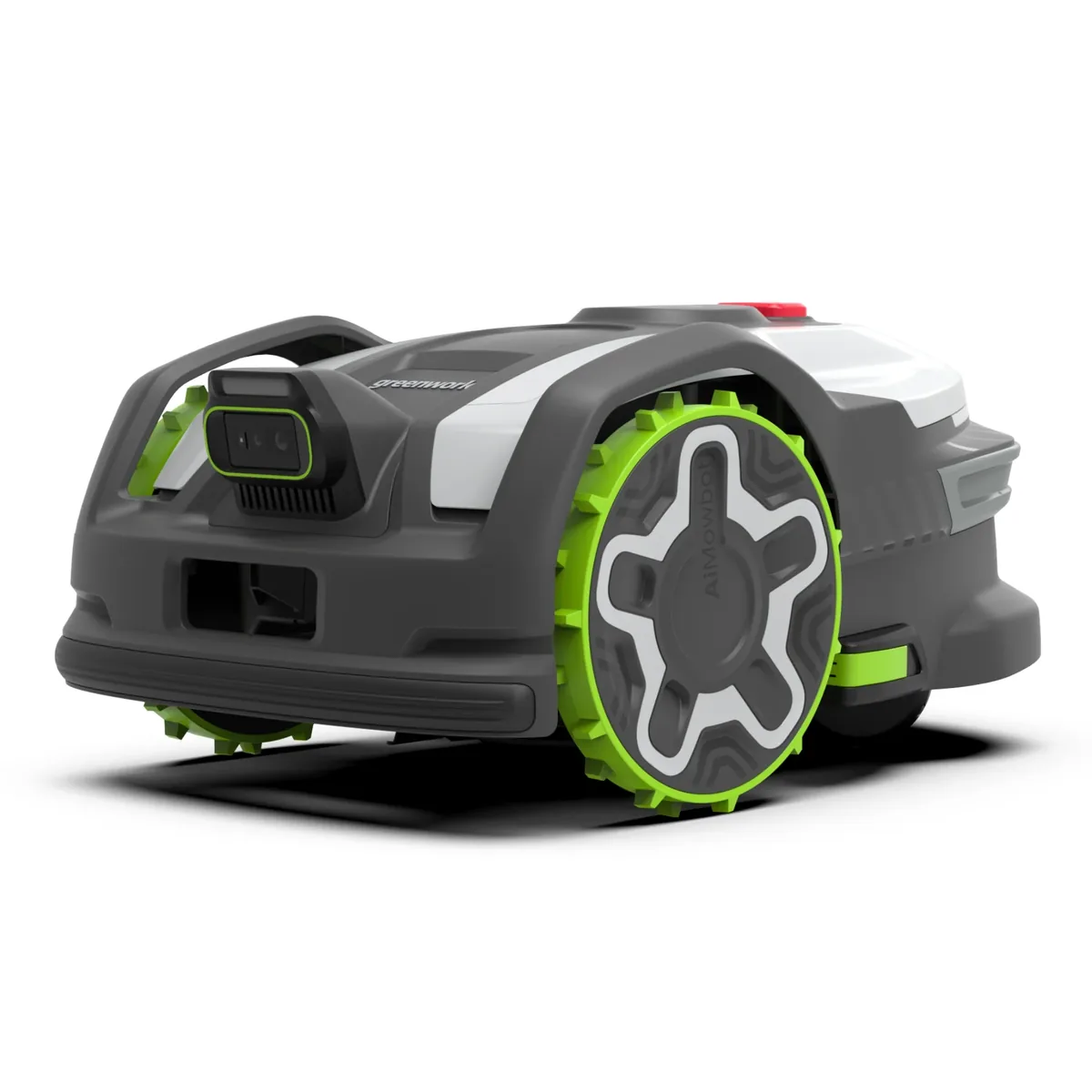
Greenworks retired the wired Optimow line for consumers in 2026 and replaced it with AiMowbot, and the C30Z is the 3/4-acre model in the front-wheel-drive C series. It uses what Greenworks calls RTKVision 2.0: an RTK reference antenna kit in the box for roughly 1 in positioning, with cameras and night-vision sensors that help it hold its line under trees and spot 200-plus obstacle types. Mowing zones, paths and no-go areas are drawn in the app; there is no wire to bury. The spec sheet is strong for $1,599.99: 45% (24 degree) slopes, an electric height adjuster from 0.75 to 3.5 in, a 54 dB noise rating, IPX6 washdown, LED headlights and a 50-minute charge. It is a front-wheel-drive three-wheeler, so it is not a Luba-style AWD climber, and the 8 in cut is narrower than a Mammotion Yuka's. Two things to weigh before buying: 4G and anti-theft tracking need a subscription Greenworks has not priced publicly, and edge cutting is rated at 4 in from the border, so keep the string trimmer. The 1/2-acre C20 ($999.99) and 1-acre C40 ($1,499.99) are the siblings and the G series adds AWD. It is a 2026 launch with no owner track record yet, which is worth remembering given how much grief the old Optimow app caused. Best for 1/2- to 3/4-acre yards with moderate slopes and a buyer who wants a 3-year warranty behind a wire-free mower.
Mammotion
Mammotion Yuka
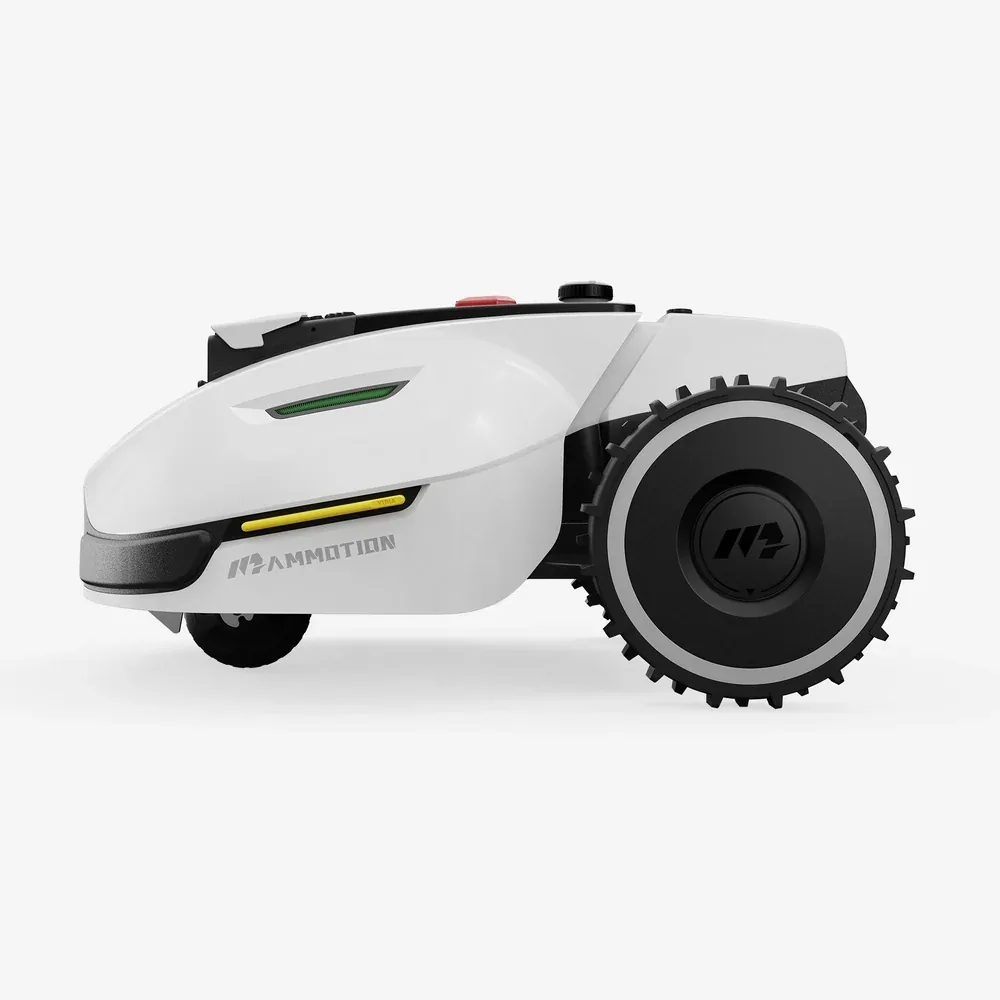
The Yuka is Mammotion's two-wheel-drive mower with a party trick nobody else has: an optional $700 sweeper cart that collects clippings and leaves, then dumps them at spots you pick in the app. The 12.6 inch dual-disc deck is nearly as wide as a Luba's, the 1.2 to 4.0 inch height range suits any US grass, and the 2025 lineup runs 1000, 2000 and 3000 square meters (a quarter to three-quarter acre). Positioning is an included RTK station plus a front AI camera; owners with open lawns love it, while a vocal minority in tree-heavy neighborhoods say it simply cannot hold position without clear sky, so this is not the pick for a wooded lot. Rear-wheel drive also means it bogs on rough or soggy ground, and the sweeper, while clever, gets stuck now and then. Mammotion's US store no longer lists the Yuka (the LiDAR-based Yuka mini 2 is its future), but Home Depot and Best Buy still stock it, with the 3000 around $1,449 on sale. If you want an AWD alternative at similar money look at the Luba 2 AWD X clearance; if you want a station-free RWD mower for a small yard, the Yuka mini 2. Best for flat, open lawns up to 3/4 acre with heavy leaf drop.
Segway
Segway Navimow X330
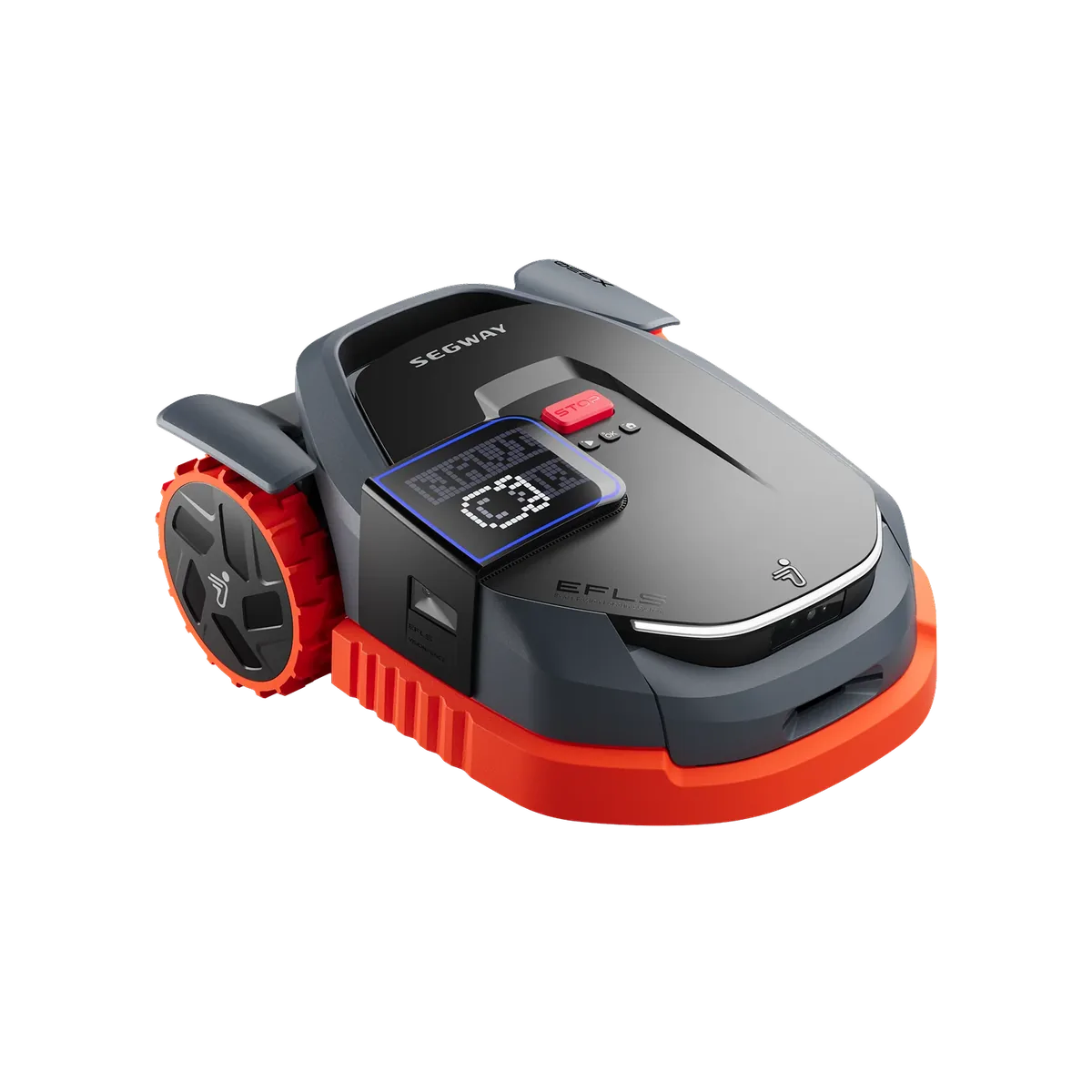
The X330 is the X3 model most people should look at: a one-acre rating, 8Ah battery for about 160 minutes of mowing with a 65 minute recharge, and it sits at $2,299 on Segway's site after a $500 cut from launch pricing. Like the rest of the X3 line it runs EFLS 3.0 - RTK fused with three cameras doing visual SLAM - so it holds position under tree canopy where the older H series and most budget RTK mowers lose lock, and its 300-degree camera plus ToF array recognizes 200+ obstacles with night vision. It mows fast (about 3.3 ft/s) in tidy parallel stripes, cuts 2 to 4 inches, runs at 60 dB, and includes two years of 4G with GPS tracking before the roughly $33 a year Connect+ renewal. Pro Tool Reviews and Robot Review Desk both call the X3 the most polished wire-free mower for flat-to-moderate suburban lots. Where it falls short: two-wheel drive makes the 50% slope rating shaky on side-hills, there is no physical rain sensor (it relies on forecasts), the centered 9.3 in disc leaves a few inches uncut along walls unless you buy the Trimmer accessory, and 43.7 lb is a lot to lift over a curb. Against the Mammotion Luba 2 AWD 3000, the X330 is quicker and gentler on turf but the Luba climbs 80% grades. For a one-acre yard with trees and gentle slopes, this is the sweet spot of the range.