Your First Robot-Mower Season: Lawn Prep, Install, Pets, Theft, and What to Expect
The reviews cover the mower. Nobody covers the first month, which is when most of the returns happen and most of the delight starts. This is what the first season actually looks like, from the week before the box arrives to the day you realize you haven't thought about mowing in a month.
The week before: prep the lawn, not the mower
Mow the lawn short one last time with your regular mower, because a robot mower is built to maintain a lawn, not to bring a hayfield down, and it will struggle and shred if it starts on six inches of growth. Walk the yard and fill the holes, pull the sticks, find every sprinkler head and either sink it flush or mark it. Decide where the base station goes: on level ground, near power, with a straight run of grass in front of it, and (for RTK) with the antenna somewhere high and open.
Then decide the cut height, and set it high for the first two weeks. Owners who start at the final height on a bumpy lawn spend the first fortnight rescuing a grounded mower. Drop it a notch a week.
Install day, wire and wire-free
Wire install is an afternoon: peg the wire around the perimeter and every island at the maker's specified distance from edges (further from walls and beds, closer to a flush mowing strip), run the guide wire back to the dock, connect it, and confirm the base sees the loop. Most owners peg it above ground and let the grass grow over it in a few weeks; burying is neater and takes longer. Buy extra pegs and a spare splice kit before you need them.
Wire-free install is an hour: mount the antenna, dock the mower, let it find satellites, then drive it around the perimeter and each island with the phone as a joystick, and set the channels between zones. Expect to redo a corner. Then set a schedule that mows more often than feels necessary (most days, part of the day) because that's the model: a little grass every day, mulched back in, never a bag.
The first month: what the lawn does
Week one looks worse. A random-pattern wire mower leaves the lawn looking oddly nibbled; an RTK mower leaves visible passes with a few missed strips while you tune the overlap. Week two it evens out. By week four owners describe a lawn that is thicker and greener than the weekly-mow version, because daily mulching feeds it and the grass never gets the shock of losing a third of its height at once. The stripes never come from a random mower and do come, faintly, from a systematic one.
What doesn't fix itself: the edges. Wire mowers cut to the wire, which is inches inside the true edge; wire-free mowers get closer but still leave a strip along fences and beds. You will trim, or you will lay a paver mowing strip flush with the grass so the mower can run its blades over the edge. Owners call the mowing strip the best money they spent on the whole project.
Dogs, kids, hedgehogs, and hoses
The safety record is good in the ways that matter: the blades are small and recessed under a wide skirt, lift and tilt sensors stop them instantly, bumpers and cameras stop the mower for a person or a dog. Run the schedule when the yard is empty, and don't let kids ride it. The realistic hazards are the ones the sensors don't see well: a garden hose left out, a dog toy in the grass, a small animal in long grass at night (European owners lobby hard against night mowing for the hedgehogs). Camera and LiDAR mowers are far better at all of these than bumper-only wire mowers.
And the universal complaint: dog poop. No mower avoids it reliably, and a mower that drives through it smears it across the lawn and its own underside. The fix is a yard walk before the mow window, and a schedule the dog isn't part of.
Theft, and the two things that actually go wrong
Theft is rarer than the forums make it sound. Every mower has a PIN, a lift alarm, and a base it can't work without; the cellular models add GPS tracking and geofence alerts, and a stolen mower is a brick without the PIN. Keep the base station out of reach of the sidewalk and you've done most of what matters.
The two things that will actually go wrong: a wire break (wire mowers) or a signal dropout (RTK) that stops the mower mid-lawn, and a stuck mower in a hole or against a root that needs a walk out to free it. Both fade as you fix the causes in the first month. After that, the honest experience of most long-term owners is a lawn that is mowed every day by a machine they check on from the couch.
Mowers mentioned in this guide
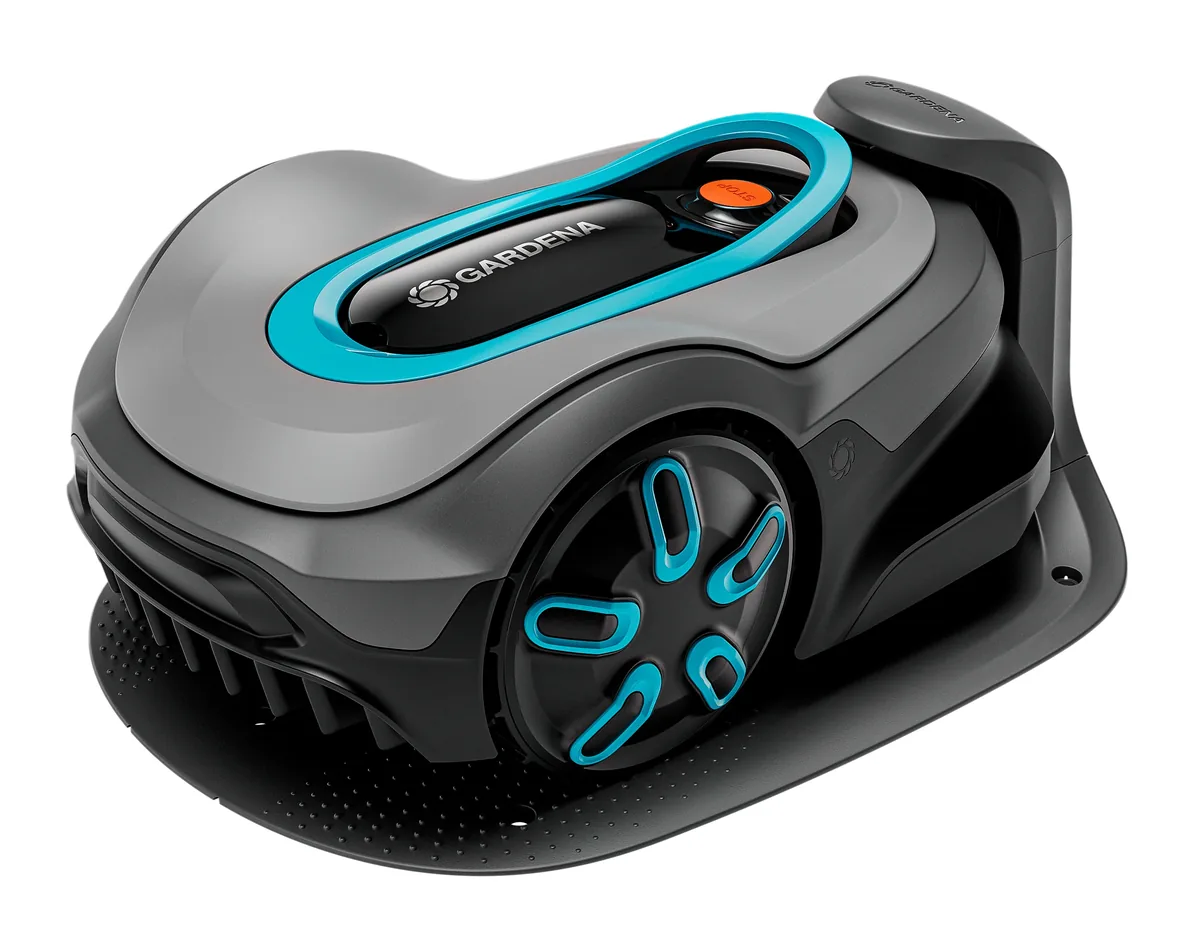
Gardena
Gardena SILENO flex
The SILENO flex is Gardena's 2025 redesign for the US and, at $599, the cheapest wired mower here from a major brand. It fixes the biggest complaint about the older SILENO City and Life: cut height now runs 1 to 4 in instead of topping out at 2 in, so it finally suits cool-season American lawns. Coverage is up to 8,600 sq ft, slopes up to 35%, and a 10 in cut on an 18V 3.6Ah pack gives about 90 minutes of mowing per 60-minute charge. Navigation is boundary wire plus a guide wire, which is still the most precise way to keep a robot out of the flower beds and lets it thread narrow corridors. It mows in the rain (there is no rain sensor by design, only a frost sensor), is quiet at 60 dB, and is hose-washable. The trade-offs are Gardena's usual ones: the app is Bluetooth-only with roughly a 33 ft range, so no remote start, notifications or GPS, and obstacle handling is a bumper. Anti-theft is a PIN plus a lift alarm. Versus the Worx Landroid M (around $900 street) you get a taller cut and a lower price but lose Wi-Fi control; versus a wire-free Segway Navimow i105 at $999 you give up couch control for a system that never loses satellite lock. Best for small, complex lawns under 0.2 acre where a wire is acceptable and quiet matters.
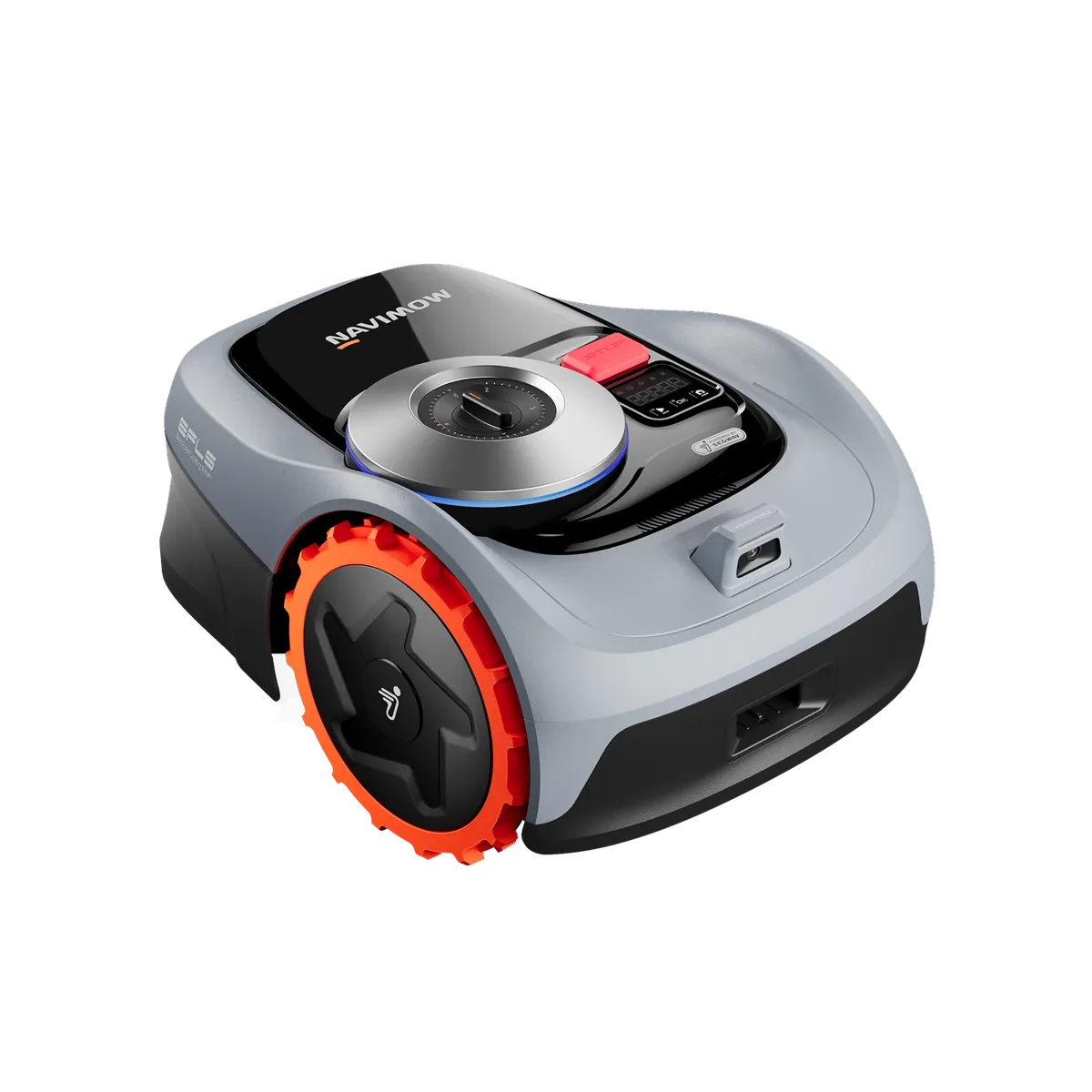
Segway
Segway Navimow i105N
The i105N is the mower that made wire-free RTK cheap. Segway cut it from $999 to $799 in 2026 and it regularly dips to $669-699, which puts it in Worx Landroid Vision territory while still using a proper RTK antenna for centimeter-level positioning. It is small - 7.1 in cutting width, 24 lb, a 2.55Ah battery good for about an hour - so the rated 1/8 acre is honest; Amazon owners with a typical city lot say a full cut takes around 2.5 hours across two or three charge cycles. Setup is genuinely DIY: mount the antenna somewhere with open sky, drive the mower around the perimeter with your phone, and let AI Assist Mapping snap to the lawn edges. Owners like the quiet 58 dB motor, the straight-line stripes, and that it pays for itself in a season versus a lawn service. The knocks are consistent too: getting stuck on flat ground and in dips, mapping frustration when trees hang over the antenna, a manual cutting-height dial, and a few units dying after a few months with slow email-only support. The 30% slope limit and front-wheel drive rule out anything hilly. Compared with the Mammotion Yuka Mini, the i105N is cheaper and simpler but has no vision-only mode when RTK is hopeless; step up to the i110N if you have more than about 5,000 sq ft.
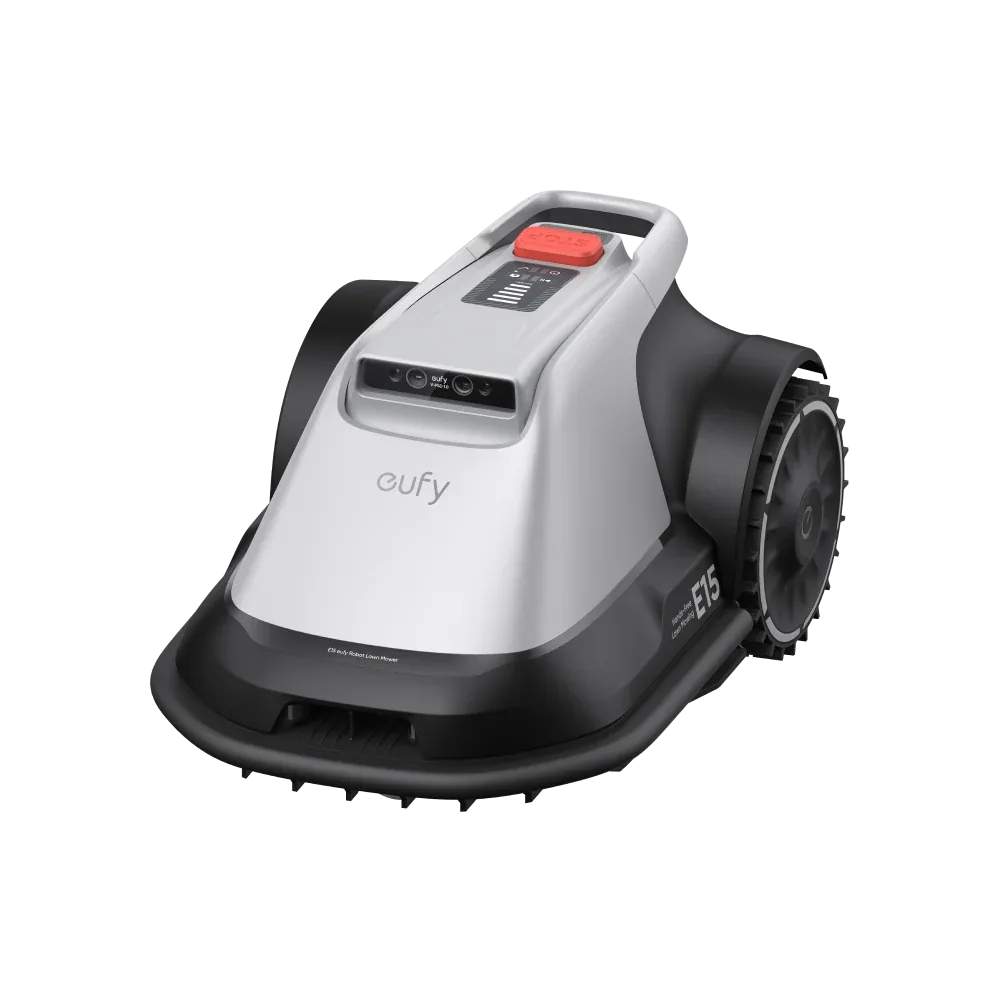
eufy
eufy E15
The eufy E15 is the robot mower for people who already own a robot vacuum and want the lawn version: unbox it, plug in the roofed base station, and its twin stereo cameras auto-map a 0.2-acre yard in 10 to 25 minutes with no wire, no RTK antenna and no perimeter drive. TechRadar, How-To Geek and Amazon owners all rave about how painless that first day is, and the 56 dB cut from three razor blades on an 8-inch disc leaves tidy stripes. The camera-only approach has real limits, though. It cannot mow after dark, it is rated for only 18-degree (about 32%) slopes, its rear-drive plastic wheels slip on dewy grass, it wants lawn edges that look different from the lawn, and Tom's Guide watched it misread longer grass and skip patches. Grass within about 4 inches of walls still needs a trimmer. It is an Anker product underneath (the mower is a rebadged TerraMow), so the app is polished, build quality is high, and you get built-in 4G, GPS anti-theft alerts, an AirTag slot and a 2-year warranty. eufy lists it at $1,799.99 but it has sold at $1,299.99 or less for most of 2026, which puts it against the Ecovacs GOAT O1000 RTK and Segway Navimow i110N; the E15 is easier to set up than either, while those two handle shade, slopes and night mowing better. Best for flat, fenced suburban lawns under 8,700 sq ft where setup simplicity matters most.
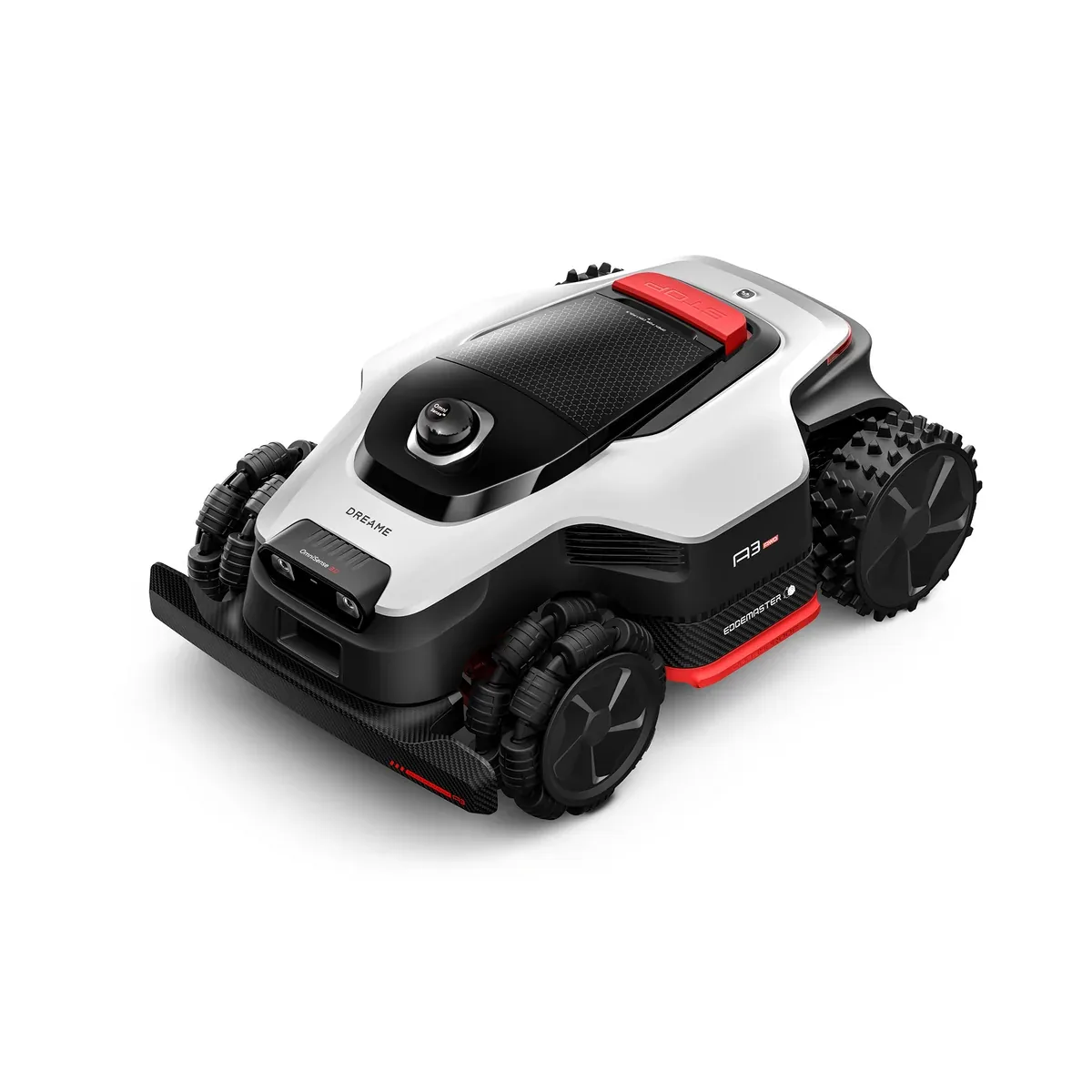
Dreame
Dreame A3 AWD
The A3 AWD is Dreame's real entry into the US market after the A1, A1 Pro and A2 stayed in Europe, and it is the cheapest all-wheel-drive, no-RTK mower you can buy from a major brand. It shares the OmniSense 3.0 stack with the A3 AWD Pro: a 360-degree 3D LiDAR on the hood plus binocular AI cameras that map the yard on their own and recognize about 300 obstacle types. Four hub motors and knobby rear tires give it an 80% (38.7-degree) slope rating that leaves rear-drive rivals like the Ecovacs GOAT O1000 LiDAR Pro and Segway Navimow i110N far behind. It comes as a 1000 (0.25 acre, $1,599.99 on sale from $1,999.99) or 2000 (0.5 acre, $1,899.99) that differ only in battery and coverage. The trade-off versus the Pro is a single 7.9-inch disc rather than dual 15.8-inch discs, so it covers ground slowly, and the EdgeMaster sliding disc leaves under 1.9 inches at borders instead of 1.2. Reviews on Dreame's store are strong (4.3 stars) and owners praise the AWD for not getting stuck in bumpy yards, but Amazon owners are harsher: a weed a few inches tall can register as an obstacle, mapping takes several tries, the dock tower can pop apart, and support has been slow. Built-in 4G with three free years, an AirTag slot and a 3-year warranty sweeten it. Best for hilly or lumpy lots under half an acre where slope matters more than speed.