Robot Mowers on Slopes, Bumps and Wet Grass: What the Slope Rating Doesn't Tell You
The slope rating is the second number people look at and the first one that lies by omission. It is a percentage, measured on dry grass, in the middle of the lawn, and it says nothing about the boundary, the bumps, or the morning after rain. This guide is the version of that number you can actually plan around.
Percent, degrees, and what they feel like
Makers quote slope in percent: rise divided by run. A 25% slope climbs one foot for every four forward, which is about 14 degrees and is where a walk-behind mower starts to feel like work. 45% is 24 degrees, a bank you would rather not carry a mower up. 80% is 39 degrees and is genuinely steep; the AWD flagships and tracked mowers that claim it are doing something impressive. Percent and degrees diverge fast, which is why the catalog shows both.
Most suburban lawns are under 15% and any mower in the catalog handles them. The ratings only start deciding purchases when there is a real feature: a bank down to the sidewalk, a swale, a terraced yard, the hill behind a walkout basement.
The boundary limit is the real limit
The headline rating is for the interior of the lawn, where the mower crosses the slope and turns on flatter ground somewhere else. At the boundary it has to stop and turn on the slope itself, and every maker publishes a lower perimeter figure for that, often half the headline. A mower rated 45% may be rated 15-20% at the edge. If your steepest ground is at the edge of the lawn (it usually is; that's where the grade change is), the perimeter number is the one to shop by.
Wire and RTK mowers both have this problem; the wire mower can at least run a wire a little inside the steep edge, and the RTK mower can draw the boundary there. Either way you are giving up a strip of grass to keep the mower from sliding out of bounds.
Wet grass, clay, and aeration
Ratings are measured dry. Wet grass roughly halves the traction of a rear-wheel-drive mower, and clay soil that turns to grease after rain, or a lawn just aerated and top-dressed, halves it again. The owner reports are consistent: RWD mowers rated for 30% spin their wheels on a damp 15-20% bank, dig ruts, and trigger the tilt sensor. Rain sensors exist for this reason as much as for clumping; leave them on, and on a sloped yard, extend the delay after rain.
Bumps and holes are the other terrain tax. A robot mower's deck rides low, and a mole run, a sprinkler-head crater, or a root will ground the skirt or lift a wheel. Fill the holes, mark the sprinkler heads, and set the cut height above the worst of the bumps for the first season.
AWD, tracks, and where the money goes
| Steepest ground | Dry, sandy soil | Wet or clay soil |
|---|---|---|
| Under 15% | Any mower | Any mower; keep the rain delay on |
| 15-25% | RWD rated 30%+ | AWD, or RWD with the boundary set off the slope |
| 25-40% | AWD rated 45%+ | AWD rated 60%+, or tracks |
| Over 40% | AWD rated 70%+ or tracks | Tracks, and expect to fence the edge |
All-wheel drive is the one spec that changes behavior on slopes rather than just the number on the box. Husqvarna's AWD Automowers, Mammotion's Luba line, and the tracked Lymow One Plus climb wet banks that strand RWD machines, hold a straight line across a hill instead of crabbing downslope, and turn at the boundary without sliding. The premium is real (AWD starts in the low $2,000s) and on a flat lawn it buys nothing.
The practical decision: measure your steepest edge, not your steepest middle. Under 15% everywhere, ignore this guide and buy on navigation and lawn size. 15-25% with wet soil or a boundary on the slope, shop AWD. Over 30% anywhere the mower has to go, AWD is the floor and a tracked machine is worth a look.
Mowers mentioned in this guide
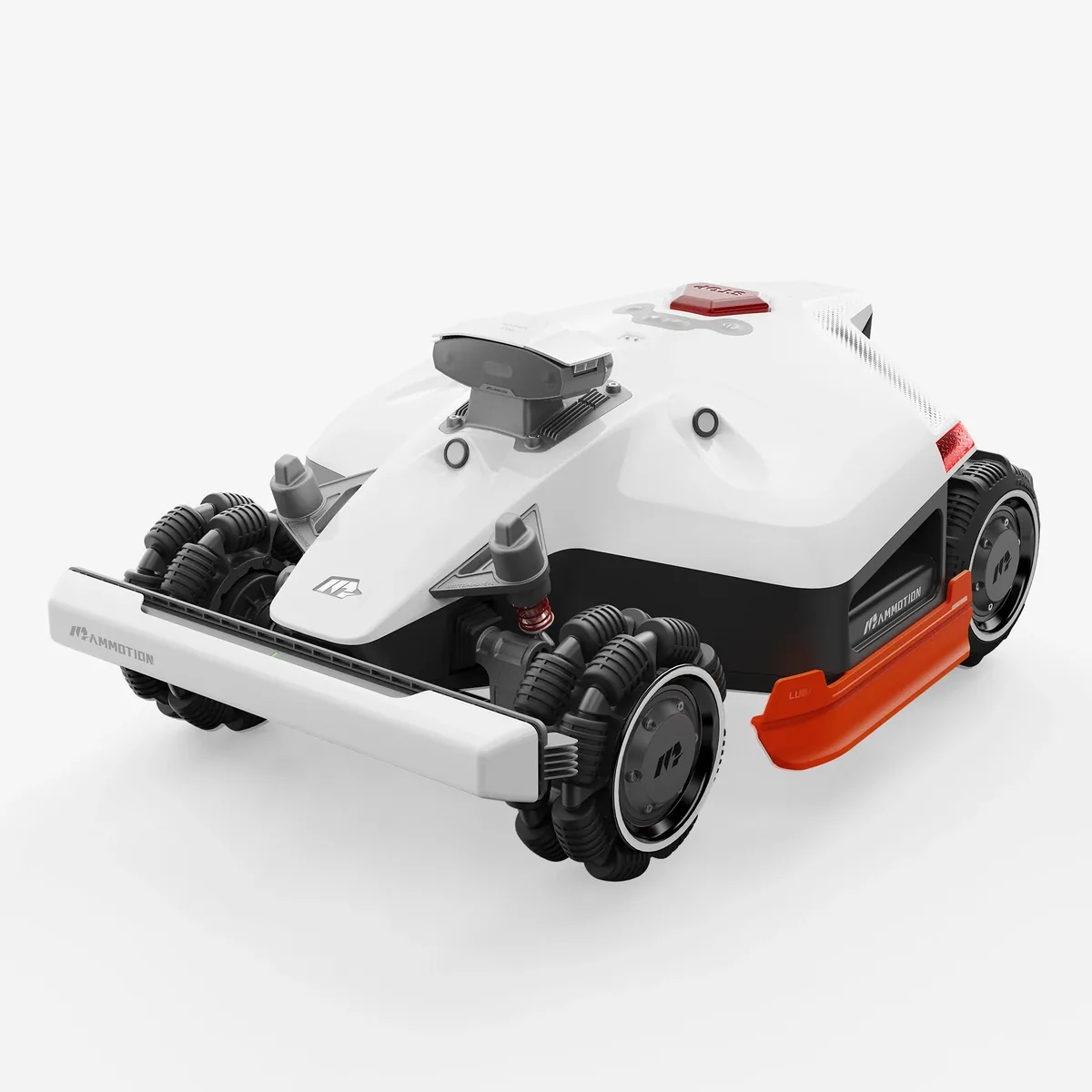
Mammotion
Mammotion Luba 2 AWD X
The Luba 2 AWD X is the mower that made Mammotion a household name in the US, and in fall 2026 it is a clearance buy: Mammotion's own store shows every trim out of stock with a banner pointing at the Luba 3, but Home Depot and Best Buy still have units, with the 3000X down from $2,599 to about $1,999. What you get is the same all-wheel-drive body that climbs 80 percent grades, a 15.7 inch dual-disc deck that clears a big yard fast, and a 2025 X refresh that added the UltraSense AI camera so it keeps its bearings when the RTK station loses sky. The catch is that RTK station: it must be mounted high with an open view, and most owner complaints trace back to a poorly placed antenna. The X version cuts 1.0 to 2.7 inches, so northern cool-season lawns should look for the HX (2.2 to 4.0 inches) instead. Versus the newer Luba 3 you give up LiDAR and free NetRTK, which matters if your lawn is ringed by trees; versus a Segway Navimow X3 you gain real AWD and a wider deck. Best for hilly half-acre to 2.5 acre properties with decent sky, bought on discount.
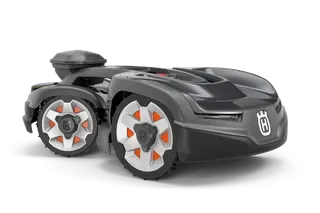
Husqvarna
Husqvarna Automower 435 iQ AWD
This is the mower for the yard that scares other robots: the 435 iQ AWD pairs all-wheel drive and an articulated, pivoting rear body with Husqvarna's EPOS wire-free navigation, and it is rated for 70 percent slopes, roughly 35 degrees, on up to 1.3 acres. Owners on Husqvarna's site describe steep waterfront lawns and ditches they used to mow in cleats now being handled without a wire in the ground, and the few complaints are about tall landscape edging confusing it and slow satellite lock rather than traction. The cut is narrower than the 4-series at 8.7 inches with a 1.2-to-2.8-inch height range, so it is not the pick for tall cool-season grass, and ultrasonic sensors rather than radar handle obstacles. At $5,000 it is the most expensive residential Automower and roughly double the price of a Mammotion Luba 2 AWD 5000, which also climbs hills and cuts wider. What you are paying for is the dealer network, a four-year warranty, and a chassis that has been proving itself on hilly lawns since the 435X AWD debuted in 2019. If your slopes are under 45 percent, save money with a 420 iQ; if they are not, this is the safest bet in the category.
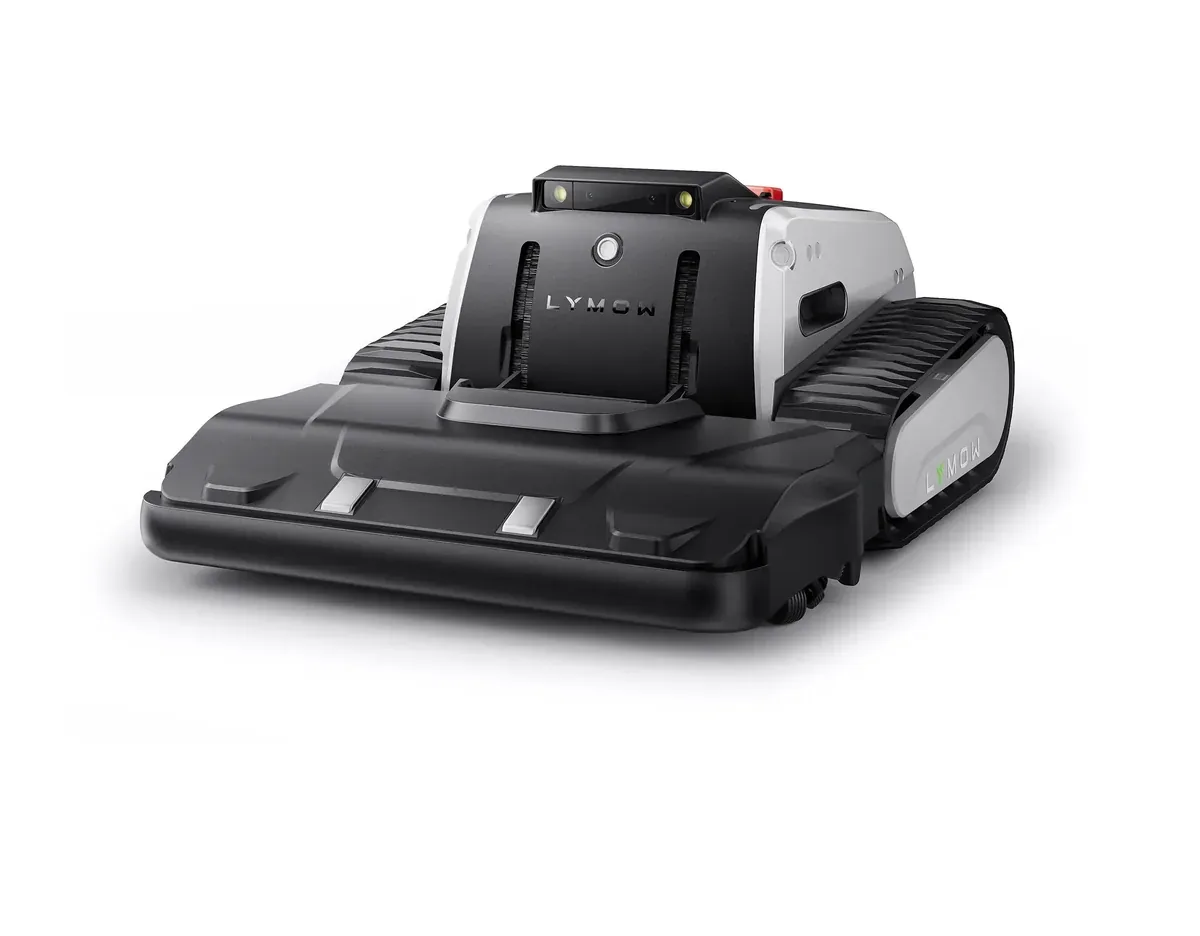
Lymow
Lymow One Plus
The Lymow One Plus is the tank of the robot mower world: it rides on rubber tracks instead of wheels, weighs almost 80 pounds, and swings two SK5 steel rotary blades across a 16-inch deck at up to 6,000 rpm. That combination is why it climbs a rated 45-degree (100 percent) slope and chews through tall, thick grass and fall leaves that stall a disc-blade mower like the Mammotion Luba 2 or a Segway Navimow. It replaced the original Lymow One in 2026 with about 50 percent more cutting power, a 528 Wh LiFePO4 battery good for roughly three hours, and a 90-minute fast charger on the 10A kit (the cheaper 5A kit takes about 150 minutes). Navigation is RTK plus VSLAM cameras, so the included RTK antenna needs open sky, then you drive the perimeter in the app to build up to 80 zones. The trade-offs are real: it is louder than a typical robot (about 62 dB in standard mode, 74 dB in turbo), it is not built for tight, fussy edges, and owners on Lymow's own site mention occasional offline drops and RTK hiccups that firmware updates have been chipping away at. If you have an acre or more of rough, hilly ground and were about to buy a small riding mower, this is the robot to look at. If your lot is a flat quarter acre full of beds, a lighter wheeled mower does the job for less.
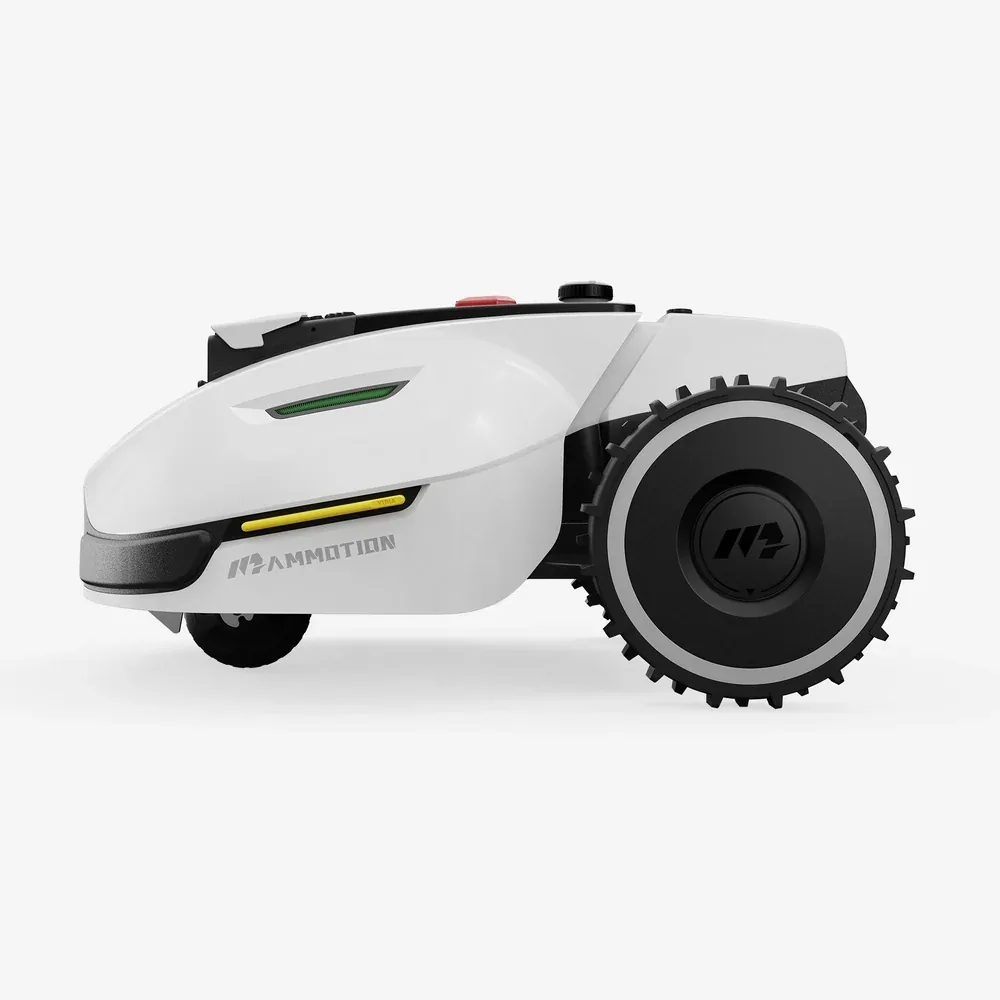
Mammotion
Mammotion Yuka
The Yuka is Mammotion's two-wheel-drive mower with a party trick nobody else has: an optional $700 sweeper cart that collects clippings and leaves, then dumps them at spots you pick in the app. The 12.6 inch dual-disc deck is nearly as wide as a Luba's, the 1.2 to 4.0 inch height range suits any US grass, and the 2025 lineup runs 1000, 2000 and 3000 square meters (a quarter to three-quarter acre). Positioning is an included RTK station plus a front AI camera; owners with open lawns love it, while a vocal minority in tree-heavy neighborhoods say it simply cannot hold position without clear sky, so this is not the pick for a wooded lot. Rear-wheel drive also means it bogs on rough or soggy ground, and the sweeper, while clever, gets stuck now and then. Mammotion's US store no longer lists the Yuka (the LiDAR-based Yuka mini 2 is its future), but Home Depot and Best Buy still stock it, with the 3000 around $1,449 on sale. If you want an AWD alternative at similar money look at the Luba 2 AWD X clearance; if you want a station-free RWD mower for a small yard, the Yuka mini 2. Best for flat, open lawns up to 3/4 acre with heavy leaf drop.